

- I have deployed over 300 agents since Claude Code and Codex shipped, and nearly every failure traced back to the prompt that built the agent in the first place.
- A working agent needs five things: a role, defined inputs, rules, a fixed output shape, and a self check.
- Search demand for AI agents for businesses is up 2,438% year over year in the US (DataForSEO, August 2026), so your competitors are about to make the same mistake at scale.
Most AI Agents Are Stupid Because the Prompt Behind Them Is Two Sentences Long
You ask it something, it answers, and you close the tab. Tomorrow you open it and do the exact same thing again, because you have to re-explain everything from scratch.
That is not an agent. That is a chat window with amnesia, and you are the one holding it together.
Here is the thing nobody selling AI agents for businesses wants to say out loud: the model is almost never the problem. Claude and GPT are both good enough to run real work today. What breaks is the foundation underneath them, and that foundation is a document you never wrote.
I have deployed over 300 agents since Claude Code and Codex came out. Client agents, internal agents, agents that run my own company while I am asleep. When one of them fails, I go looking for the bug in the wiring, and almost every time the bug is sitting in the original prompt that built the agent in the first place.
Why AI Agents for Businesses Fail (It Is Not the Model)
An owner tells me their agent "doesn't work." I ask to see the prompt. It usually reads something like this:
"You are a helpful assistant that follows up with leads. Write a friendly follow up email."
That is two sentences, and it is asking the agent to invent everything else. It does not know who this lead is, what they asked about, what a follow up sounds like in your business, or what to do when the lead already replied and there is no email on the record.
The agent has to guess, so it guesses. Sometimes it guesses well and you think the thing is magic, and sometimes it guesses badly and you decide AI is overhyped. Both outcomes come from the same missing document.
You would never hand a new hire a two sentence job description and expect consistent work. An agent is the same, except it never asks a clarifying question and it never tells you it is confused. It just produces something confident and wrong.
The fix is boring, which is probably why so few people do it. You have to write the spec.
The 5-Part Foundation for Building AI Agents
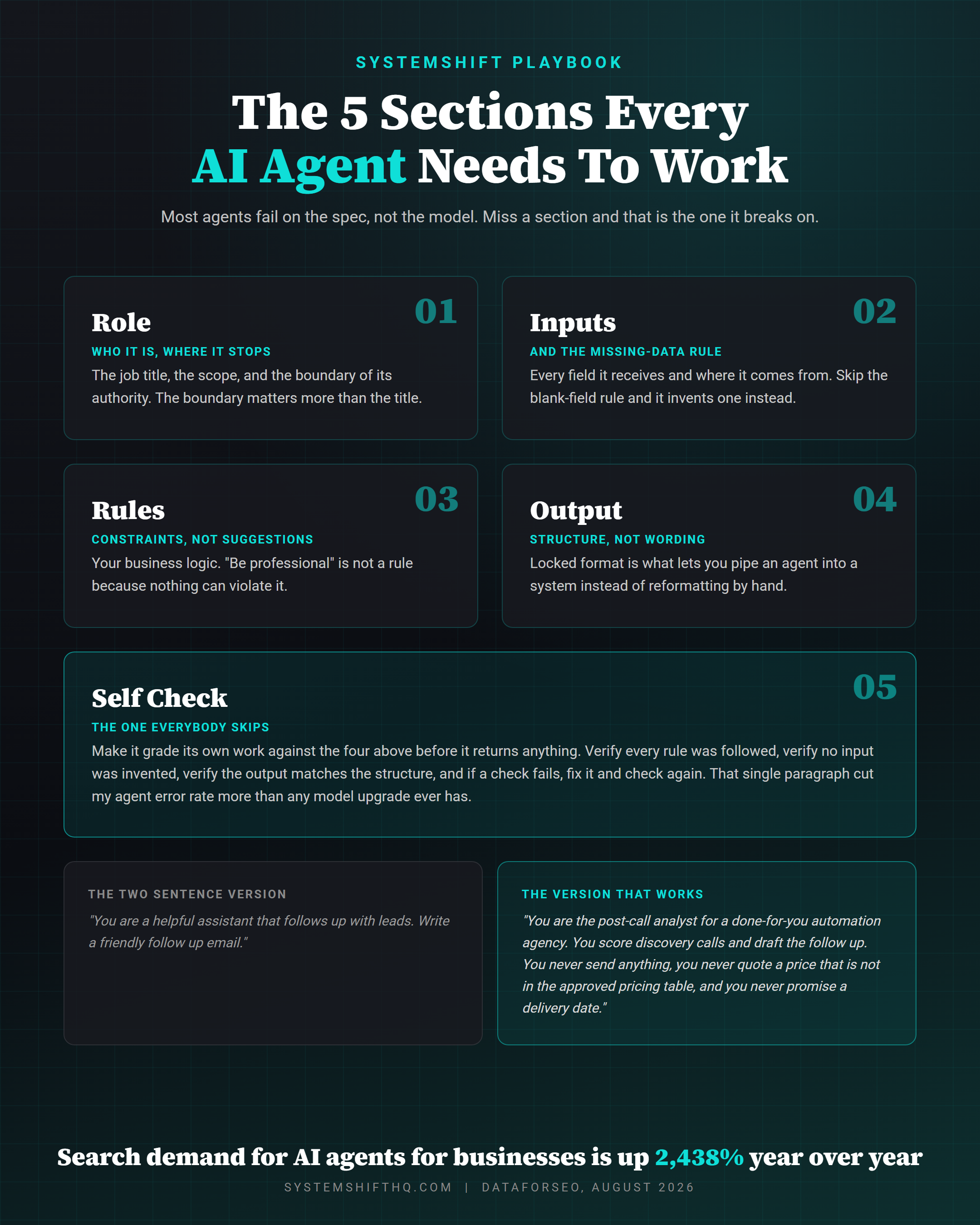
Every agent I run is built on the same five sections. If one of them is missing, that is the section the agent will fail on, and you can usually predict the failure before it happens.
1. Role
Tell the agent exactly who it is and what it owns. Not "helpful assistant," but the actual job title, the scope, and the boundary where its authority stops.
The boundary matters more than the title, because an agent without a stated limit will happily wander into work you never asked it to do. That is how you end up with a follow up email that also renegotiates your pricing.
Weak: "You are a sales assistant."
Working: "You are the post-call analyst for a done-for-you automation agency. You score discovery calls and draft the follow up. You never send anything, you never quote a price that is not in the approved pricing table, and you never promise a delivery date."
2. Inputs
Name every piece of information the agent receives, where it comes from, and what to do when a piece is missing.
That last part is the one everyone skips, and it is the single biggest source of silent garbage. If you do not tell an agent what to do with a blank field, it will fill the blank itself. It will invent a company name, assume a budget, or address someone as "there" because the first name was empty.
Write the missing-data rule explicitly. Mine usually says that if a required field is empty, the agent stops and flags it rather than substituting a guess.
3. Rules
This is your business logic, written as constraints rather than suggestions. Rules are where your actual expertise lives, and they are the reason your agent produces work that sounds like your company instead of a press release.
Good rules are specific and testable. "Be professional" is not a rule, because nothing can violate it. "Never quote a price on a first call, always reference something specific the prospect said, never promise a delivery date" are rules, because you can look at an output and tell instantly whether one got broken.
Include the negative rules too. An agent that knows what it is not allowed to touch is an agent you can actually leave alone.
4. Output
Fix the shape of what comes back, meaning the structure rather than the wording.
If you want a score, say what scale it uses and what the bands mean. If you want an email, say how many words, how many paragraphs, and where the call to action sits. If you want data, give it the exact fields in the exact order.
An agent with a locked output format is an agent you can pipe into something else, and that is the difference between a chat window and a system. Loose output means a human has to read every result and reformat it, which puts you right back where you started.
5. Self Check
Before the agent hands you anything, make it grade its own work against the four sections above.
This one sounds soft and it is the highest impact line in the whole document. You are asking the model to run one more pass and catch its own violations, which it is genuinely good at when you tell it what to look for.
Mine reads roughly like this: before returning, verify every rule was followed, verify no required input was invented, verify the output matches the required structure, and if any check fails, fix it and check again.
That single paragraph cut my agent error rate more than any model upgrade ever has.
What This Looks Like Across Real AI Agents Use Cases
I run my company on five agents, and every one of them is built on those five sections.
Monday is sales, so I take every call myself. My closer agent scores the call afterward and drafts both the proposal and the follow up, working from a rules section that holds my actual pricing table and my actual disqualifiers.
Tuesday is delivery, and my client success agent sends every client their update, recap, and next steps. Its inputs section tells it exactly which project fields to pull and what to do when a field is stale.
Wednesday I record video and talk through ideas out loud. One agent cuts the Instagram posts and another builds the LinkedIn graphics, both working off an output section that locks dimensions, font, and caption length so nothing comes back off brand.
Thursday I check what actually shipped, because my ops agent hands me the queue at 6am and flags whatever stalled.
Friday I train my two people and study for two hours, with no client work at all.
That is roughly twenty hours a week from me, and the other half of the work runs nights and weekends without me re-explaining context to anything.
The rule that got me here is simple: if a task shows up twice, it stops being mine. An agent takes it, and the agent gets a real spec before it takes it.
AI Agents for Small Business: Start With One
You do not need five agents. You need one that actually works, because one reliable agent will teach you more than five flaky ones ever will.
Pick the task you did twice this week and resented both times. Write the five sections for it, give the agent ten real examples of the work, then run it and read every output for a week before you trust it with anything unsupervised.
Then measure it, because building it right and knowing it works are two different jobs with two different scoreboards. I covered the second one in AI Agent Evaluation, which walks through the four metrics that tell you whether an agent is earning its keep.
If you want to see finished examples before writing your own, 3 AI Agents Every Business Owner Can Use breaks down three from our stack with the real outputs attached.
And if the task you picked has no documented process behind it yet, fix that first, because an agent built on an undocumented process just automates confusion faster. Documenting Standard Operating Procedures covers which processes to write down and in what order.
The Window Is Closing on the Easy Version of This
Search demand for AI agents for businesses is up 2,438% year over year in the US, and the term now runs about 1,600 searches a month with unusually low competition (DataForSEO, August 2026). Another 49,500 people a month search "ai agents" outright.
Most of them are going to paste a two sentence prompt into a chat window, get an inconsistent result, and write the whole category off as hype. That is your opening.
The owners who win the next two years are not the ones with the best model, because everyone has the same models. They are the ones who wrote the spec.
FAQ
What makes an AI agent different from just using ChatGPT or Claude?
A chat session starts from zero every time and depends on you supplying context by hand, while an agent carries a written foundation with it, connects to your real tools and data, and produces the same output shape every run. If you are re-explaining your business at the start of each session, you have a chat window rather than an agent.
How long should the prompt behind an AI agent be?
Longer than you think and shorter than a manual. Most of mine run one to three pages covering the five sections. The test is not length, it is whether someone unfamiliar with the job could follow the document and produce acceptable work.
Do AI agents for small business need a developer?
No, and that changed recently. The hard part used to be the wiring, so you needed someone technical. The hard part now is the spec, which is a writing job and a thinking job, so if you can write a clear job description for a new hire you can write the foundation for an agent.
Why does my agent work great for a week and then get worse?
It probably did not get worse, your inputs changed. New lead sources, renamed fields, or a new offer that never made it into the rules section. When an agent degrades, check what changed upstream before you blame the model.
Where to Start
Take the one task that showed up twice on your calendar this week and write the role, the inputs, the rules, the output, and the self check for it. Run it ten times before you trust it once.
If you would rather not start from a blank page, book a call and we will map which parts of your business should have an agent behind them, and which parts still need a process before they get one.
Ready to Automate Your Business?
Book a free strategy call and we'll map out exactly what to build first.
Book Your Call
Join the Conversation